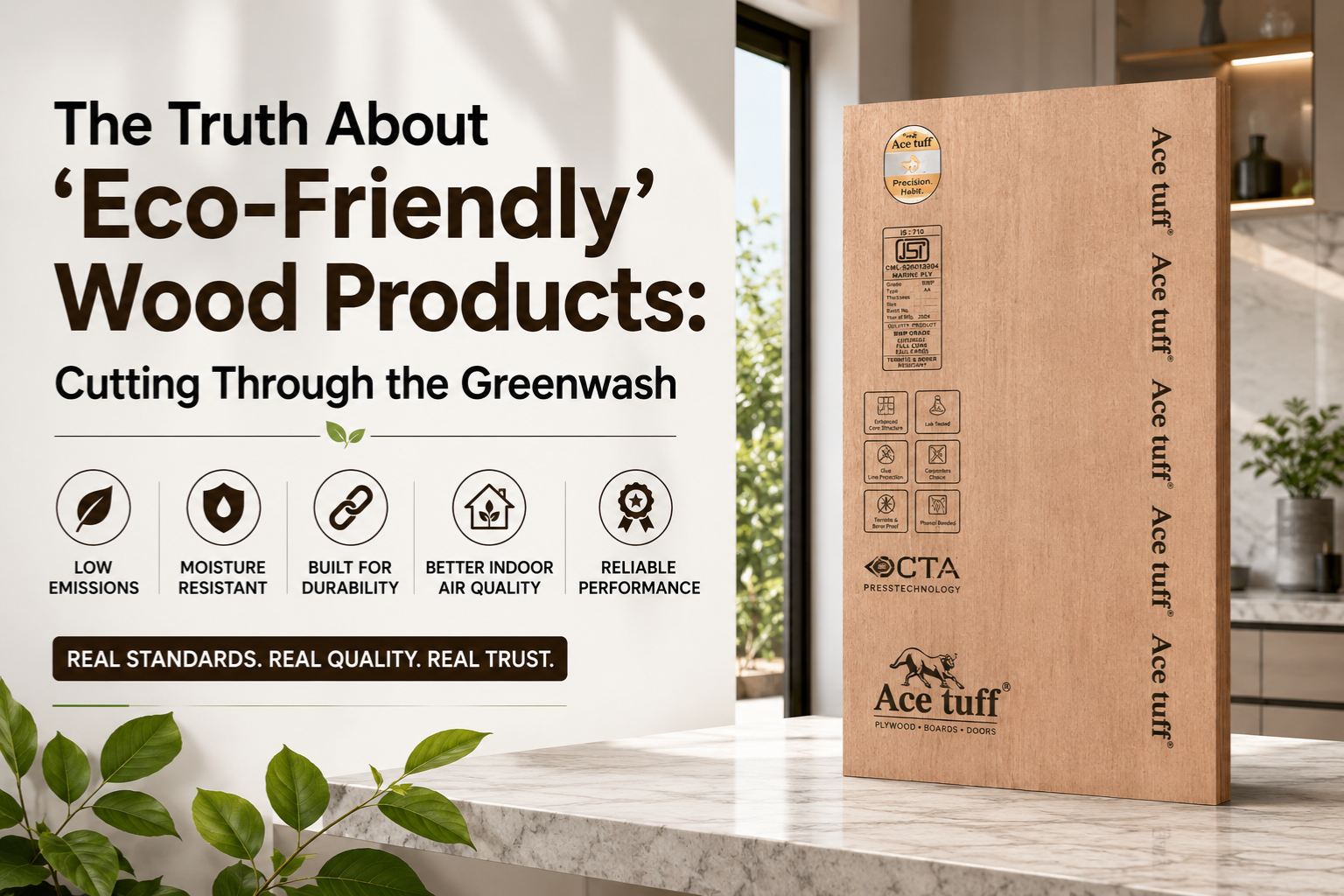
The Truth About “Eco-Friendly” Wood Products: Cutting Through the Greenwash
- May 16, 2026
In today’s interior and furniture market, the term “eco-friendly” appears everywhere. From plywood sheets to modular furniture boards, almost every brand claims to be sustainable, green, or environmentally safe. But here’s the reality most buyers discover too late — not every “eco-friendly plywood” product actually protects your indoor environment.
Imagine a family investing lakhs into a beautiful modular kitchen. The finish looks premium, the furniture feels sturdy, and everything appears perfect. But within months, there’s a strange smell inside the cabinets, the edges begin swelling near the sink, and the indoor air starts feeling heavy. The problem often isn’t the design — it’s the material hidden beneath the laminate.
This is where choosing the right plywood becomes critical.
At Acetuff Ply, the focus goes beyond marketing labels. The emphasis is on durability, moisture resistance, structural stability, and safer material choices that support modern interiors without compromising long-term performance.
Defining Eco-Friendly Plywood Beyond Marketing Claims
Many homeowners assume that eco-friendly plywood simply means “made from wood.” In reality, true eco-friendly plywood is defined by how it is manufactured, the type of adhesives used, and how safely it performs over time inside enclosed spaces.
High-quality eco-friendly plywood is designed to:
- Minimise harmful emissions
- Improve indoor air quality
- Resist moisture-related damage
- Maintain long-term structural stability
- Support sustainable sourcing practices
The biggest concern in low-quality plywood is often formaldehyde emissions released from adhesives and resins. Poor-quality boards can continue releasing harmful compounds for months after installation.
This becomes especially important in:
- Modular kitchens
- Bedrooms
- Wardrobes
- Children’s furniture
- Office cabins
- Retail counters
Pro Tip:
Whenever buying plywood, don’t rely only on the word “eco-friendly.” Ask about certifications, resin quality, moisture resistance, and long-term performance.
Why Emission Standards Matter in Modern Interiors
Modern homes are becoming more compact and enclosed. Large wardrobes, floor-to-ceiling storage, modular kitchens, and false wall panelling reduce ventilation inside interiors. If the plywood used inside these spaces releases harmful chemicals, those emissions can remain trapped indoors.
This is why low-emission and safer plywood materials matter more than ever.
Premium-quality plywood solutions like those offered by Acetuff Ply are designed for modern interior applications where durability and safer indoor environments are equally important.
Designing Beautiful Interiors Without Compromising Indoor Comfort
One of the biggest myths is that sustainable or eco-friendly plywood limits creativity. In reality, it gives homeowners and designers more confidence to build stylish enclosed spaces safely.
Popular Interior Applications
Modular Kitchens
Kitchen furniture constantly faces steam, moisture, and temperature changes. Using strong moisture-resistant plywood helps maintain durability for years.
Floor-to-Ceiling Wardrobes
Large wardrobes trap air inside enclosed spaces. Stable plywood helps reduce swelling, bending, and long-term damage.
TV Units & Wall Panelling
Minimalist living rooms often include hidden storage and decorative panels. Good plywood ensures smooth finishing and dimensional stability.
Home Office Furniture
Work-from-home setups require durable desks, shelves, and storage systems that can handle daily usage.
Children’s Room Furniture
Parents today prefer safer material choices for study tables, beds, and wardrobes used by children every day.
Pro Tip:
For high-contact areas like kitchens and wardrobes, always prioritise plywood performance over short-term savings.
Choosing the Right Plywood Variant for Your Project
Not every plywood type is suitable for every application. Understanding the right grade and thickness can prevent expensive repairs later.
1. Thickness: Choose Based on Usage
Different furniture applications require different board strengths.
Recommended Applications
- 6mm–9mm: Wall panelling and lightweight partitions
- 12mm–16mm: Wardrobes and cabinets
- 19mm+: Heavy-load furniture and structural applications
Pro Tip:
Thicker plywood improves load-bearing strength and durability in frequently used furniture.
2. Understanding Plywood Grades
BWP (Boiling Water Proof)
Ideal for:
- Kitchens
- Bathrooms
- Utility areas
BWP plywood offers maximum resistance against water exposure and humidity.
BWR (Boiling Water Resistant)
Suitable for:
- Dining areas
- Living room furniture
- Moderate moisture environments
MR (Moisture Resistant)
Best for:
- Bedrooms
- Study rooms
- Dry interior spaces
Real-World Example:
A homeowner may save money using MR plywood in a kitchen cabinet initially, but constant moisture exposure can eventually cause swelling and edge damage. Choosing BWP-grade plywood from the start often prevents costly replacements later.
Why Durability Matters More Than Initial Cost
Many buyers compare plywood only based on price per sheet. However, cheaper plywood often leads to:
- Faster delamination
- Edge swelling
- Reduced furniture lifespan
- Higher maintenance costs
- Frequent repairs
Premium plywood may initially cost slightly more, but the long-term savings can be significant.
Practical Benefit:
Strong plywood reduces future renovation expenses while maintaining furniture appearance and structural integrity for years.
Key Benefits of Choosing Acetuff Ply
Strong Performance in Real-Life Conditions
Modern interiors face daily challenges:
- Water exposure
- Humidity
- Heavy usage
- Heat
- Furniture load stress
Acetuff Ply focuses on performance-oriented plywood solutions designed for practical everyday use.
Better Structural Stability
Quality resin systems improve:
- Dimensional stability
- Resistance against bending
- Reduced warping
- Lower swelling risk
This becomes especially valuable in kitchens, wardrobes, and storage furniture.
Long-Term Furniture Reliability
Stable plywood improves:
- Furniture lifespan
- Laminate bonding
- Surface smoothness
- Screw holding capacity
Pro Tip:
Furniture durability depends more on the plywood inside than the laminate visible outside.
Real Applications Where Plywood Quality Truly Matters
The quality of plywood directly impacts both appearance and performance across residential and commercial interiors.
Residential Spaces
- Modular kitchens
- Bedrooms
- TV units
- Storage systems
- Study rooms
Commercial Spaces
- Retail counters
- Office workstations
- Hotel furniture
- Display fixtures
Storytelling Scenario:
A retail showroom using low-grade boards may begin showing edge damage within a year due to heavy customer interaction. In contrast, premium plywood maintains both finish quality and structural strength even under continuous daily usage.
Common Mistakes Buyers Should Avoid
1. Trusting Marketing Claims Without Verification
Not every product labelled “green” or “eco-friendly” delivers actual performance benefits.
Actionable Tip:
Always ask for technical specifications and grade details before purchasing.
2. Choosing the Wrong Grade
Using interior-grade plywood in moisture-prone areas leads to early damage.
Quick Rule:
- Kitchen = BWP
- Moderate moisture = BWR
- Dry interiors = MR
3. Focusing Only on Price
The cheapest option often becomes the most expensive after repairs and replacements.
4. Ignoring Installation Quality
Even premium plywood can underperform if:
- Edges are left unsealed
- Waterproofing is ignored
- Installation quality is poor
Pro Tip:
Good plywood and proper installation should always work together.
Smart Buying Guide for Eco-Friendly Plywood
Before finalising plywood for your next project, ask these important questions:
Checklist for Buyers
- What plywood grade is recommended?
- Is it suitable for moisture exposure?
- What resin system is used?
- Does the plywood offer dimensional stability?
- Is it suitable for modular furniture?
- What is the expected lifespan?
- Is the plywood designed for heavy daily usage?
Final Thoughts
The truth about eco-friendly wood products is simple: labels alone don’t guarantee quality. Real performance comes from the right manufacturing standards, strong material composition, reliable moisture resistance, and long-term durability.
Modern interiors demand more than attractive finishes. Homeowners, architects, and interior designers now need materials that perform consistently under real-life conditions while supporting healthier and more reliable living spaces.
Choosing quality plywood is not just about furniture. It’s about creating interiors that remain strong, stable, and dependable for years.
With performance-focused solutions from Acetuff Ply, homeowners can build interiors that combine durability, functionality, and long-term confidence without falling for greenwashed marketing claims.