How to Choose Safe, Non-Toxic Plywood for Kids’ Rooms: A Complete Guide for Parents
- November 17, 2026
Creating a beautiful room for your child is exciting. From choosing colourful furniture to designing a comfortable study corner, every detail matters. But have you ever wondered whether the plywood used in your child’s bed, wardrobe, or study table could affect the air they breathe?
Plywood is one of the most widely used materials in modern furniture and interior design. However, not all plywood products are manufactured using the same adhesives and resins. Some wood-based panels can release chemicals, including formaldehyde, into the surrounding air.
This is why choosing low-emission, non-toxic plywood for kids’ rooms deserves special attention.
Whether you are designing a nursery, renovating a children’s bedroom, or purchasing new furniture, understanding plywood safety can help you make informed decisions.
Let’s explore how to identify safer plywood, understand important certifications, and create a healthier indoor environment for your family.
1. Understanding the Formaldehyde Problem in Plywood
Imagine you’ve just installed a beautiful new wardrobe in your child’s bedroom. Everything looks perfect, but you notice a strong chemical smell when you enter the room.
That smell may come from adhesives, finishes, or other materials used during furniture manufacturing. Although smell alone cannot reliably indicate whether a product is safe, it is a good reason to investigate the materials used.
What Is Formaldehyde?
Formaldehyde is a chemical commonly used in certain adhesives and resins that bond thin wooden layers together during plywood manufacturing.
Some formaldehyde-based resins can release small amounts of the chemical into indoor air over time. This process is known as formaldehyde off-gassing.
Exposure to elevated formaldehyde levels may cause:
- Irritation of the eyes, nose, and throat.
- Coughing and respiratory discomfort.
- Aggravation of asthma symptoms in sensitive individuals.
- Other health concerns associated with prolonged or significant exposure.
Children deserve particular consideration because they spend substantial time indoors and their respiratory systems are still developing.
Why Low-Emission Plywood Matters
Choosing plywood with verified low chemical emissions helps reduce an avoidable source of indoor air pollution.
For children’s furniture, parents should look beyond attractive finishes and consider the materials underneath.
Pro Tip: Before purchasing plywood, ask the dealer whether the specific product has been tested for formaldehyde emissions. Request a current test report rather than relying on terms such as “chemical-free” or “100% safe.”
2. Identifying Low-Emission Plywood Certifications
With so many plywood options available, how can you distinguish genuinely tested products from those making general safety claims?
The answer lies in recognised certifications and independent testing.
Reliable certifications help buyers understand whether a plywood product meets defined chemical-emission requirements.
Important Certifications and Standards to Know
GREENGUARD Gold Certification
GREENGUARD Gold certification evaluates products against stringent chemical-emission limits. It is particularly relevant when selecting building materials and furniture for sensitive indoor environments, including children’s rooms.
CARB Phase 2 Compliance
The California Air Resources Board’s formaldehyde emission requirements help regulate emissions from certain composite wood products, including covered hardwood plywood.
EPA TSCA Title VI Compliance
This US regulatory framework establishes formaldehyde emission standards for specified composite wood products. It is particularly useful when evaluating products intended for the American market.
FloorScore Certification
FloorScore evaluates emissions from qualifying flooring materials. It may be relevant when selecting flooring products, but it is not a general-purpose plywood certification.
Cradle to Cradle Certified
This certification considers broader material health, circularity, and sustainability criteria. However, its presence should not automatically be treated as proof that a plywood product meets a particular formaldehyde-emission limit.
Why Third-Party Testing Makes a Difference
Consider two plywood suppliers. One promotes its products as environmentally friendly, while the other provides independent chemical-emission test results.
The second supplier gives you more useful information for making a safety-conscious purchase.
Pro Tip: Check the exact product name, certification scope, validity, and testing standard. A certificate issued for one product range does not automatically apply to every plywood sheet sold by the same manufacturer.
3. Exploring FSC-Certified Plywood Options
When selecting plywood for your home, environmental responsibility is another important consideration.
This is where FSC-certified plywood becomes relevant.
What Does FSC Certification Mean?
The Forest Stewardship Council (FSC) promotes responsible forest management through recognised certification systems.
FSC certification can help consumers choose wood products associated with responsibly managed forest resources and verified supply chains.
Benefits may include:
- Supporting responsible sourcing of wood.
- Encouraging improved forest management practices.
- Helping buyers identify wood products with traceable sourcing claims.
- Supporting more environmentally conscious purchasing decisions.
Does FSC Certification Mean Plywood Is Non-Toxic?
Not necessarily.
FSC certification focuses on responsible forest management and supply-chain claims. It does not, by itself, establish that plywood adhesives have low formaldehyde emissions.
For children’s furniture, it is better to consider both responsible wood sourcing and verified chemical-emission performance.
For example, when planning a child’s study table, you can ask for FSC-certified wood-based material along with separate evidence of low formaldehyde emissions.
Pro Tip: Look for plywood that combines responsible sourcing with documented emission testing. This provides a more complete picture of environmental responsibility and indoor material quality.
4. Understanding VOC Levels in Plywood
Have you ever walked into a newly furnished room and noticed a strong smell from the furniture, paint, or adhesive?
Some of those odours may be associated with volatile organic compounds, commonly known as VOCs.
What Are VOCs?
Volatile organic compounds are chemicals that can evaporate into the air from various materials.
Common indoor sources include:
- Certain plywood adhesives and resins.
- Furniture coatings and varnishes.
- Paints and surface finishes.
- Construction adhesives.
- Some cleaning and household products.
Formaldehyde is one chemical of concern in indoor air, but VOC testing may measure many different substances.
Why Should You Choose Low-VOC Plywood?
Selecting low-VOC plywood and compatible low-emission finishes can help reduce chemical emissions from newly installed furniture.
This is especially relevant for:
- Children’s beds and cots.
- Study tables and bookshelves.
- Wardrobes and storage cabinets.
- Playroom furniture.
- Nursery shelving and wall panels.
How to Evaluate Emission Levels
Ask the manufacturer for an appropriate laboratory report showing the measured emissions, test method, and relevant limits.
For context, the US EPA TSCA Title VI standard sets a formaldehyde emission limit of 0.05 parts per million (ppm) for covered hardwood plywood.
However, different products and test methods have different criteria. A generic VOC result cannot be judged using one universal ppm threshold.
Pro Tip: Do not rely solely on claims such as “low VOC” or “zero emissions.” Compare product-specific testing results with recognised standards and check whether the surface finishes and adhesives used during installation are also low-emission.
5. Exploring Alternative Adhesive Technologies
The adhesive used during plywood manufacturing is an important factor affecting its emission performance.
Traditional plywood manufacturing may involve different formaldehyde-based resin systems, depending on the product’s intended application.
Modern adhesive technologies offer additional choices for buyers who prioritise indoor air quality.
Different Types of Plywood Adhesives
Urea-Formaldehyde (UF) Resins
UF resins are widely used in certain interior wood-based products. Their emission performance varies according to formulation and manufacturing quality.
Phenol-Formaldehyde (PF) Resins
PF resins are commonly used in applications requiring strong bonding and moisture resistance. Properly manufactured PF-bonded panels can exhibit relatively low formaldehyde emissions.
Melamine-Urea-Formaldehyde (MUF) Resins
MUF adhesives can provide improved moisture resistance compared with conventional UF systems. Actual emissions depend on the formulation and production process.
No-Added-Formaldehyde Adhesives
Some manufacturers use adhesive technologies that do not intentionally add formaldehyde-based resins, such as certain soy-based or polyurethane systems.
These options can reduce reliance on conventional formaldehyde-based adhesives, although finished boards still require testing to verify their emission performance.
Which Adhesive Is Better for Children’s Furniture?
There is no single adhesive type that guarantees a completely non-toxic product.
The best approach is to select plywood that offers the required strength, durability, and documented low-emission performance.
For example, a child’s wardrobe needs stable panels and reliable bonding, while furniture placed near a bathroom may require additional moisture resistance.
Pro Tip: Ask your plywood supplier about the bonding technology and request test reports for the finished board. The actual emissions of the manufactured product matter more than the adhesive’s marketing description.
6. Practical Tips for Selecting Safe Plywood for Kids’ Rooms
Choosing the right plywood becomes much easier when you know what to check before placing an order.
Let’s say you’re planning a bedroom renovation that includes a bed, wardrobe, and study desk.
Instead of choosing plywood based only on price or appearance, consider these practical steps.
Check the Product Documentation
Ask for technical information about the plywood’s grade, adhesive system, emission testing, and recommended applications.
Choose Suitable Plywood Grades
Different furniture applications require different levels of strength and moisture resistance.
For example:
- Study tables need stable, durable panels.
- Wardrobes require good dimensional stability and reliable bonding.
- Children’s beds need structurally suitable materials and secure construction.
- Furniture exposed to humidity may require moisture-resistant plywood.
Inspect the Plywood Quality
Look for consistent thickness, well-bonded layers, and a smooth surface without obvious defects.
Select Low-Emission Finishes
Even if the plywood has low emissions, the finished furniture can introduce additional chemicals through paints, laminates, varnishes, and adhesives.
Choose compatible, low-emission finishing materials wherever possible.
Allow Adequate Ventilation After Installation
Newly installed furniture may release chemicals from adhesives and finishes. Providing good ventilation during and after installation can help reduce indoor concentrations.
Pro Tip: Ask your carpenter to finish exposed plywood edges properly, use suitable adhesives, and remove dust and debris before your child begins using the room.
7. Why Ventilation Matters Even with Low-Emission Plywood
Choosing safer building materials is an important step, but healthy indoor air also depends on how the room is maintained.
Imagine a children’s bedroom with a new wardrobe, freshly painted walls, and recently installed furniture.
Even if each material has relatively low emissions, multiple products may contribute to indoor air pollution.
Simple Ways to Improve Indoor Air Quality
Encourage Fresh-Air Circulation
Open windows when outdoor air quality and weather conditions are suitable. Proper ventilation helps dilute pollutants released indoors.
Maintain Comfortable Indoor Conditions
Excessive heat and humidity can increase emissions from certain materials. Appropriate temperature and moisture control can support a healthier indoor environment.
Choose Suitable Air Purification
HEPA filters are effective at capturing airborne particles such as dust and some allergens. However, HEPA filtration alone does not effectively remove gaseous VOCs or formaldehyde.
For gases, an air cleaner needs an appropriate gas-phase filtration system, such as activated carbon, although effectiveness varies by design and pollutant.
Keep the Room Clean
Regular dust removal, appropriate cleaning products, and good housekeeping help maintain a more comfortable living space.
Pro Tip: When installing new furniture, ventilate the room thoroughly and follow the manufacturer’s recommendations for curing and occupancy. Air purifiers should support—not replace—source control and ventilation.
8. Making the Final Decision: Choosing the Right Plywood for Your Family
Every parent wants furniture that looks beautiful, lasts for years, and supports a comfortable home environment.
Choosing plywood for children’s rooms should therefore involve more than comparing colours, thicknesses, and prices.
A good buying decision combines:
- Verified low formaldehyde emissions.
- Reliable product quality and durability.
- Suitable plywood grades for the intended application.
- Responsible material sourcing where possible.
- Compatible low-emission adhesives and finishes.
- Proper installation and ventilation.
For example, spending a little more on plywood with reliable technical documentation can offer greater confidence than purchasing a cheaper alternative with unclear material specifications.
Where Does Acetuffply Fit Into Your Furniture Planning?
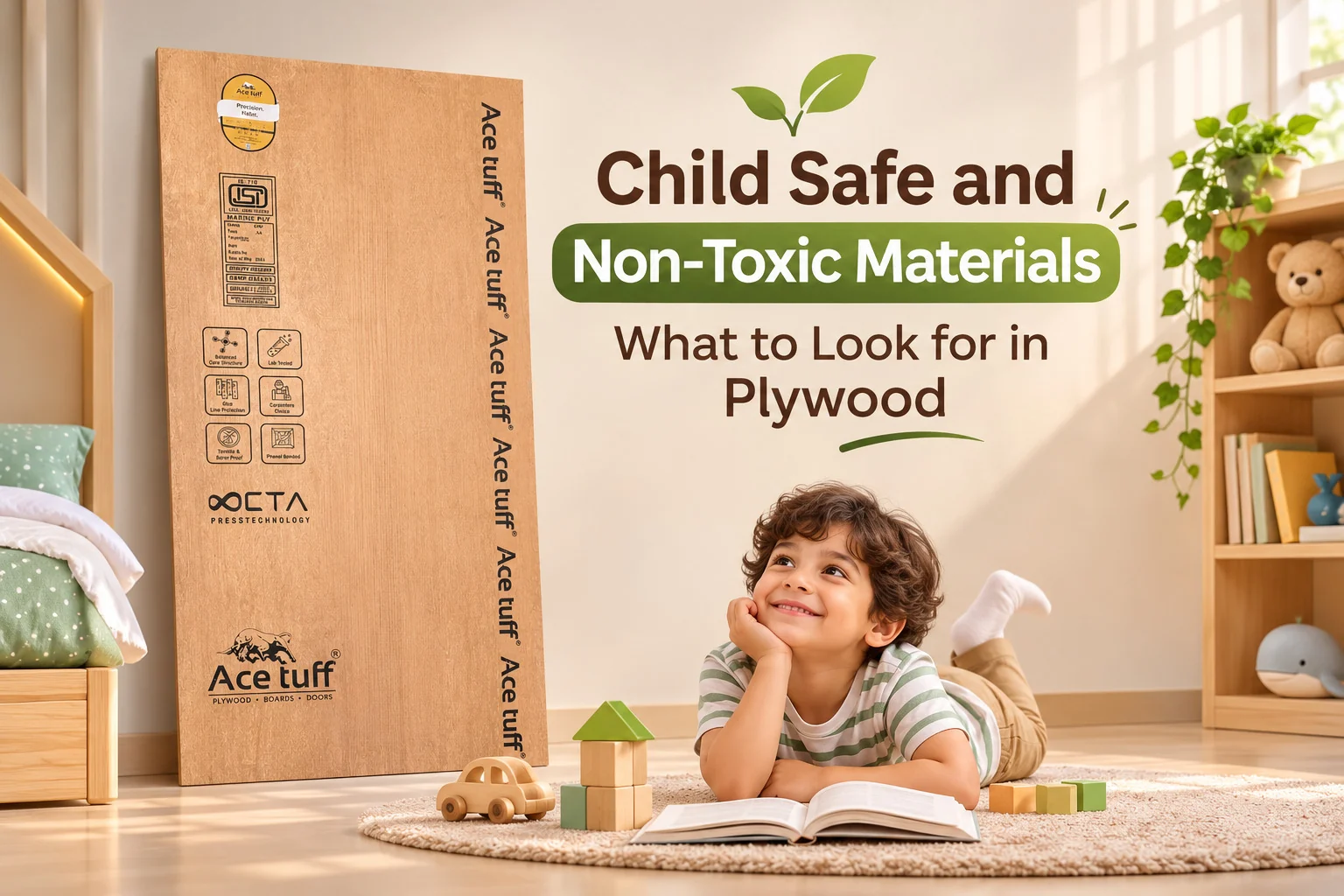
When selecting plywood for your child’s bedroom or other living spaces, Acetuffply can be included among the brands you evaluate for strength, durability, product suitability, and available technical documentation.
Before selecting a particular Acetuffply product, ask for its specifications, recommended applications, and any verified formaldehyde-emission testing or certification that applies to that product.
This helps ensure that your buying decision is based on documented performance rather than assumptions.
Pro Tip: Prioritise product-specific certification and verified performance over broad claims such as “completely chemical-free” or “100% non-toxic.” An informed selection is the foundation of a healthier furniture project.
Conclusion: Build a Safer Space for Your Child with Informed Plywood Choices
A child’s room is more than a place to sleep. It is where they learn, play, relax, and create memories.
That is why choosing the right furniture materials matters.
By understanding formaldehyde emissions, identifying reliable certifications, selecting appropriate plywood grades, and ensuring proper ventilation, you can make better decisions for your child’s living environment.
Remember that safe plywood for kids’ rooms is not determined by appearance or brand reputation alone. What matters most is documented emission performance, suitable construction quality, and responsible installation.
When planning your next furniture project, explore the available Acetuffply product range, review the relevant specifications, and select materials that meet your design, durability, and indoor-air-quality requirements.
Because a thoughtfully designed home begins with informed material choices.